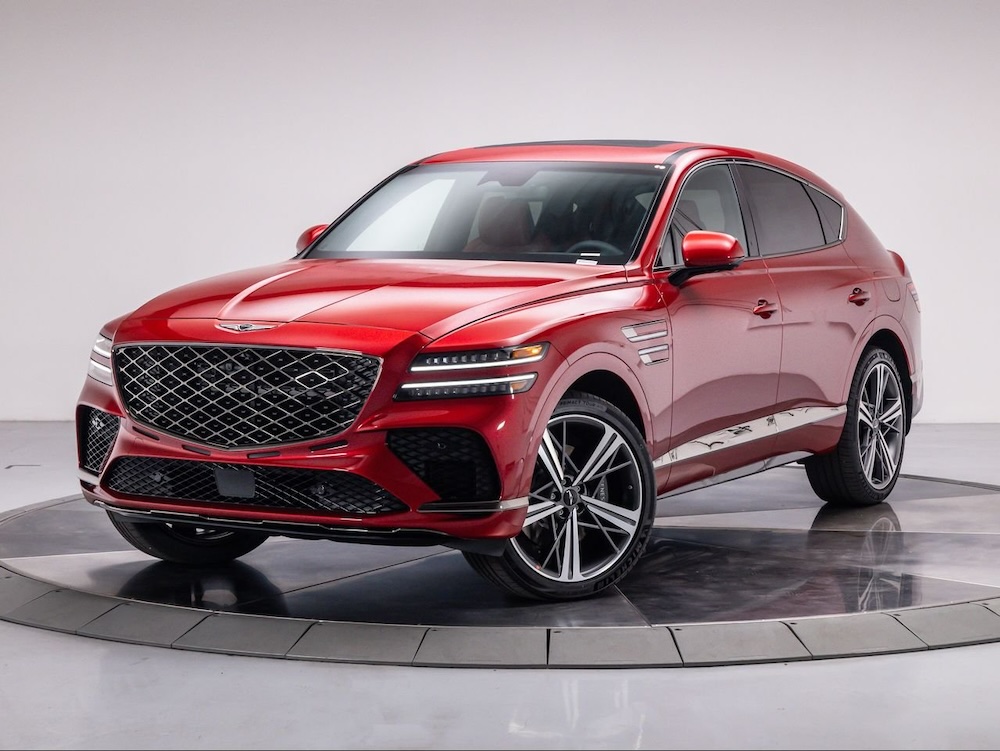
I came away from the 2026 Genesis GV80 Coupe thinking something I honestly didn’t expect: Genesis may have built one of the best-looking luxury SUVs on the road, but I’m not convinced the most expensive version is the one you should buy. This thing has presence. It looks considerably more exotic than the Genesis badge might suggest, and that’s exactly why buyers need to keep their emotions in check once they start looking at the window sticker.
The Coupe shares its bones with the regular GV80, but the sloping roof, aggressive rear end, larger available wheels and wide stance completely change its personality. It’s almost 16 and a half feet long, so don’t let the word “Coupe” fool you into thinking this is some compact sporty crossover. It’s a substantial luxury SUV that happens to trade a little practicality for a lot more style. And yes, I think that trade works visually.
I noticed this while filming the walk-around: the rear three-quarter angle is where this vehicle really sells itself. You get the long hood, wide rear shoulders and that fastback roofline all at once. Then you open the doors and realize Genesis didn’t gut the interior just to make the exterior look good. That’s important because plenty of coupe-style SUVs ask you to sacrifice more than you’d expect for the design.
There are two versions of the 3.5-liter twin-turbo V6. The standard 3.5T makes 375 horsepower and 391 pound-feet of torque, while the 48-volt e-Supercharger version bumps output to 409 horsepower and 405 pound-feet. Both use an eight-speed automatic and all-wheel drive. The regular engine isn’t exactly struggling, so don’t assume you need the 409-horsepower version just because it’s sitting one spot higher on the price sheet.
The GV80 Coupe is more grand touring SUV than sports car, and I’m good with that. There’s plenty of power, the cabin stays quiet, and the electronically controlled suspension is designed to read the road and adjust the ride before the vehicle reaches rough pavement. It also has an electronic limited-slip differential and multiple drive modes. Sport mode can wake things up, but this is still a vehicle weighing well over two and a half tons. Physics hasn’t been canceled just because the steering wheel has a flat bottom.
Here’s what I’d watch for on a test drive: find the roughest pavement you can and pay attention to the 22-inch wheel setup. Those wheels look fantastic, but appearance doesn’t matter much when you’re hitting expansion joints every morning for the next five years. Then do a tight parking maneuver and make sure you’re comfortable with the visibility out back. The surround-view cameras help tremendously, but I’d test the vehicle the way you’re actually going to use it, not just cruise around the dealer’s smoothest boulevard.
Inside is where Genesis makes the strongest argument for the price. The centerpiece is a massive 27-inch OLED display stretching across the dashboard, and the cabin is loaded with Nappa leather, a microfiber suede headliner, heated and ventilated seating and an 18-speaker Bang & Olufsen audio system. The materials look and feel expensive. More importantly, the cabin doesn’t feel like Genesis was desperately copying Germany. It has its own personality now.
You also don’t lose as much space as the roofline might suggest. There’s seating for five, good second-row legroom and about 29 cubic feet of cargo room behind the rear seats. Fold them down and you’re looking at roughly 61 cubic feet. The regular GV80 is still the smarter choice if cargo space is the priority, but the Coupe remains useful enough for luggage, golf clubs, groceries and normal family duty. Nobody buys this shape because they’re trying to maximize cubic feet.
Technology is everywhere, but most of it has a purpose. Wireless Apple CarPlay and Android Auto are here, along with a head-up display, digital rearview mirror, surround-view camera, remote parking capability and a long list of driver-assistance systems. You can even use your fingerprint for certain vehicle functions. It’s impressive stuff, although I still suggest sitting inside for 15 minutes at the dealership and actually using everything. A feature isn’t luxurious if it annoys you every morning.
Here’s how dealers will try to sell you the GV80 Coupe: they’ll park the most expensive one right up front with the biggest wheels, the best color combination and every visual upgrade, then let that become the version you think you need. The 2026 lineup starts around $81,850 for the 375-horsepower 3.5T AWD, climbs to roughly $87,650 for the e-Supercharged version, and reaches about $89,400 with Prestige Black. We’re not talking about an inexpensive alternative to a luxury SUV anymore. This is luxury-SUV money.
Here’s where you’ll overpay: chasing horsepower and appearance simply because they’re available. The e-Supercharged engine adds 34 horsepower, which is nice, but the standard engine already gives you 375. Prestige Black looks sinister with blacked-out trim, special wheels and its darker interior treatment, but nearly $90,000 changes the conversation. At that price, I want more than a really good-looking parking lot.
Here’s what I’d actually do. I’d buy the standard 3.5T AWD and keep the roughly $6,000 difference between it and the e-Supercharged model in my pocket. You’re still getting the same basic body, twin-turbo V6, AWD, excellent interior, 27-inch display and a huge amount of luxury equipment. I’d only move to the 409-horsepower version if I drove both back-to-back and genuinely felt the extra performance mattered. Never pay thousands for a specification you’re only going to brag about.
The obvious comparisons are coupe-style SUVs from BMW, Mercedes-Benz and Porsche, and that’s where the Genesis argument gets interesting. Some European competitors can easily climb well beyond the GV80 Coupe once they’re similarly equipped. Genesis gives you a tremendous amount of standard equipment for the money. But resale value and long-term brand perception matter too, especially when you’re spending close to six figures. The purchase price isn’t the only number I’d research.
Fuel economy isn’t going to win anybody over either. Expect roughly 19 mpg combined depending on the powertrain, and premium fuel is the smart choice if you want the advertised performance. On the upside, towing capacity reaches 6,000 pounds with the proper equipment, and Genesis backs the vehicle with a five-year/60,000-mile new-vehicle warranty, a 10-year/100,000-mile powertrain warranty for the original owner and three years or 36,000 miles of scheduled maintenance. Now tell me this: if you had $90,000 to spend, are you taking this over a BMW, Mercedes or Porsche? I’d genuinely like to know.
My verdict is pretty simple. The 2026 Genesis GV80 Coupe looks expensive, feels expensive and finally carries itself like Genesis belongs in this part of the market. I’d skip the temptation to max it out and buy the 375-horsepower 3.5T AWD because that’s where the value still makes sense. The styling is the star, the interior is arguably the closer, and 375 horsepower is plenty. Before you buy one, compare real dealer pricing and availability in your area at Quotes.EverymanDriver.com. A beautiful SUV can still be a bad deal if you pay too much for it.