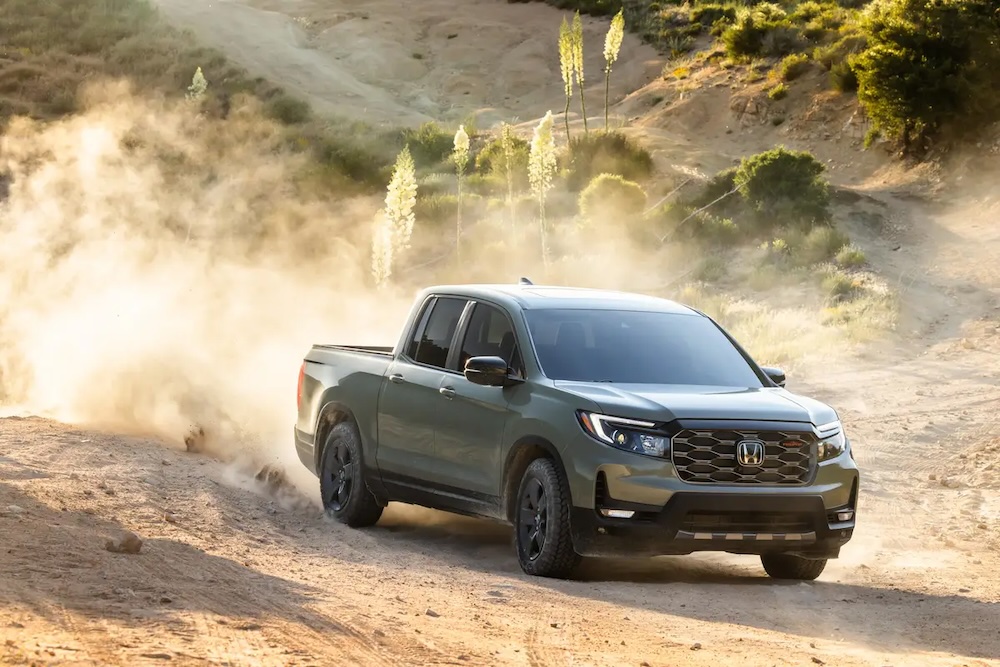
The more time I spend around the 2026 Honda Ridgeline TrailSport, the more I think a lot of truck buyers are shopping backward. They start with towing numbers, ground clearance and off-road capability they may use twice a year, then spend the other 363 days driving a truck that rides worse, gets harder to park and costs more to live with. The Ridgeline takes the opposite approach. It’s comfortable first, useful second and just rugged enough to handle most of what normal people actually do. That may not win every truck argument, but it makes a lot of sense in the real world.
This is the pickup for somebody who wants a truck bed but doesn’t necessarily want the full traditional-truck experience. Commuters, homeowners, active families, cyclists, campers and weekend DIY people should absolutely look at it. If you’re regularly towing heavy trailers, crawling over serious rocks or need maximum payload capability, skip it. Buy the truck built for that job. The Ridgeline isn’t pretending to be a heavy-duty workhorse, and that’s part of why I like it.
The TrailSport is also the Ridgeline I’d want sitting in my driveway. Honda gives it a different grille, all-terrain tires, an off-road-tuned suspension, skid protection and just enough rugged detail to separate it from the regular models. The available Ash Green Metallic works especially well on this trim. In person, it’s still unmistakably a Ridgeline, but the TrailSport treatment makes it look less like a crossover with a bed and more like something you’d actually want to take camping.
Inside, Honda doesn’t try to overwhelm you. The layout is straightforward, the controls are easy to figure out and the leather-trimmed seats with orange stitching add a little personality without looking goofy. You get a moonroof, heated front seats, tri-zone climate control and a heated steering wheel on the TrailSport. Does it feel like a $45,000-plus truck? Mostly, yes. You’re paying more for refinement and usability than flashy materials, and I’m fine with that.
The front seats are where the Ridgeline starts making its case against more traditional midsize pickups. The driving position feels natural, visibility is good and you don’t feel like you’re sitting inside a narrow bunker. Here’s what I’d watch for on a test drive: don’t just drive it around the block. Find a broken section of pavement, railroad tracks and a tight parking lot, then drive those same spots in another midsize truck you’re considering. That’s where you’ll understand what you’re paying for.
Technology is refreshingly simple. There’s a 9-inch touchscreen with wireless Apple CarPlay and Android Auto, wireless phone charging and Honda’s familiar driver-assistance features. TrailSport also includes navigation and parking sensors. The screen isn’t enormous, and frankly, I don’t care. Bigger isn’t automatically better. I’d rather have a system I can understand in thirty seconds than a giant tablet that makes me hunt through menus just to do something simple.
Power comes from Honda’s 3.5-liter V6 paired with a nine-speed automatic and standard i-VTM4 all-wheel drive. It makes 280 horsepower and 262 pound-feet of torque, and that’s plenty for what this truck is designed to do. Acceleration is smooth, the transmission doesn’t constantly call attention to itself and the V6 feels relaxed at highway speeds. No, this isn’t the truck for somebody trying to win stoplight races. It just gets on with the job.
Where the Ridgeline really separates itself is ride quality. The unibody construction gives it a more settled, SUV-like feel than many body-on-frame pickups, and the TrailSport suspension doesn’t ruin that. Steering is predictable, highway driving is comfortable and the AWD system adds confidence when the weather turns ugly. While filming around the TrailSport, that’s what kept standing out to me: I wasn’t constantly thinking about the fact that I was driving a pickup. For somebody using one every day, that’s a compliment.
The back seat is legitimately useful too. Adults can sit back there without feeling punished, and the wide cabin works well for kids and car seats. The rear seat bottoms also flip up, opening a surprisingly useful storage area inside the cab. That feature doesn’t photograph particularly well for a brochure, but owners are going to use it constantly for backpacks, groceries, tools, muddy gear or anything else they’d rather not throw in the bed.
And then there’s the bed, which might be the smartest part of the entire truck. The floor is wide and flat, the tailgate can either drop normally or swing open sideways, and underneath the bed is a lockable 7.3-cubic-foot trunk with a drain plug. That’s one of those features that sounds strange until you own it. Tools stay hidden. Groceries don’t roll around. Wet gear has somewhere to go. You can even use it like a giant built-in cooler. The Ridgeline can also tow up to 5,000 pounds, which is enough for plenty of boats, smaller campers and utility trailers, but serious towing buyers should look elsewhere.
The Sport starts around $40,800, the RTL around $43,600 and the TrailSport around $46,000 before options and fees. Here’s what I’d actually do: I’d buy the regular TrailSport and stop there. It gives you the off-road suspension, all-terrain tires, skid plate and the equipment that makes this version different. I’d skip paying extra just to get the HPD wheel package unless you absolutely love the look, and I’d think twice about moving into the Black Edition simply because it’s sitting under the showroom lights looking expensive. Here’s how dealers will try to upsell you: wheels, appearance packages and accessories that can turn a sensible Ridgeline into a nearly $50,000 purchase pretty quickly. Cross-shop it against the Toyota Tacoma, Ford Ranger and Nissan Frontier, but be honest about how you’ll actually use your truck.
Best thing about it: this may be the easiest midsize pickup to live with every single day. Biggest limitation: towing and serious off-road capability don’t match the tougher body-on-frame trucks. My pick: TrailSport, without piling on unnecessary accessories. The question I’d ask is simple—if you rarely tow more than 5,000 pounds or crawl over rocks, how much truck do you really need? Before you buy, compare real dealer pricing at Quotes.EverymanDriver.com and make dealers compete for your business.