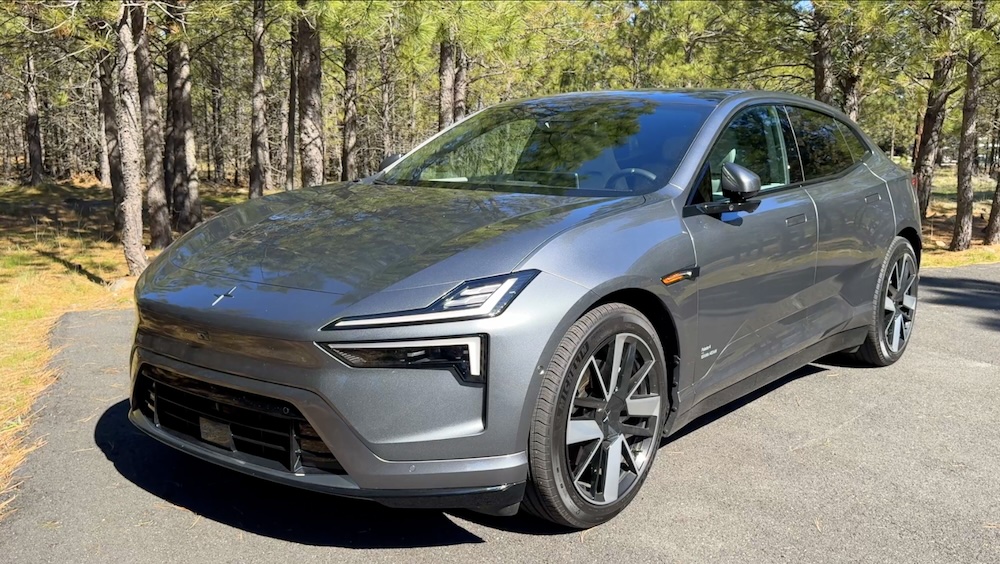
I didn’t expect the 2026 Polestar 4 Dual Motor Pilot & Plus to be one of the more interesting EVs I’ve looked at lately, but here we are. On paper, it sounds like another sleek premium electric crossover. In person, it feels like Polestar decided normal was boring and just kept going. That’s good news if you want something different. It’s bad news if you’re the type of buyer who needs every design choice to make instant practical sense.
The first number buyers need to understand is price. The Long range Dual motor starts at $62,900 MSRP, and Polestar’s U.S. configurator shows the Pilot pack included while the Plus pack adds $5,500. So if you want the Dual Motor in the Pilot & Plus setup, you’re at roughly $68,400 before destination and before any extras. That’s not insane for a premium EV, but it’s also not cheap enough to excuse a lazy decision. Here’s where you’ll overpay: falling for the design first and asking value questions later.
The performance is real. The Dual Motor makes 544 horsepower and 506 lb-ft of torque, sends power to all four wheels, and Polestar says it’ll do 0 to 60 in 3.7 seconds with a 124-mph top speed. Those are not “pretty quick for an EV” numbers. Those are genuinely fast numbers. This thing moves. Quick enough that the Polestar 4 stops feeling like a stylish commuter and starts feeling like a premium performance toy with a practical side hustle.
But speed always sends a bill, and in this case that bill shows up in range. The Dual Motor is EPA-rated at 280 miles, with an EPA estimate of about 90 city, 80 highway, and 85 combined MPGe. Energy consumption is listed at roughly 40 kWh per 100 miles. That is respectable, not class-leading. I’m not here to sugarcoat it: for the money, some buyers are going to want more distance on a charge. Polestar is clearly betting that design and performance will make you care a little less.
Charging helps soften that tradeoff. The Polestar 4 uses a 100-kWh battery, supports DC fast charging at up to 200 kW, and Polestar says it can go from 10 to 80 percent in about 30 minutes. On 11-kW AC charging, it’s about 11 hours from empty to full. In plain English, it’s modern enough to be easy to live with, but not so dominant that it rewrites the class. Solid EV credentials. No miracle here.
Dimensionally, this thing tells you what it wants to be. It rides on a 118-inch wheelbase, measures 190.5 inches long, 60.4 inches tall, and 84.2 inches wide with the mirrors out. In other words, it’s low, wide, and visually planted. It does not look like a traditional upright family SUV, and that’s the point. This is Polestar chasing style on purpose, not accidentally backing into it.
Then there’s the elephant in the room, or more accurately, the glass missing from the back of the car. No rear window. Polestar replaces it with an 8.9-inch digital rearview display fed by a roof-mounted camera. That’s the conversation starter, the deal-maker, and the deal-breaker all wrapped into one. Clever? Absolutely. Risky? Also yes. Some buyers will think it’s brilliant in five minutes. Others will hate it before they leave the lot.
The rest of the cabin is much easier to defend. You get a 15.4-inch center display, a 10.2-inch driver display, Android Automotive with Google built in, Apple CarPlay support, and with the Plus pack you add a 14.7-inch head-up display, a 5.7-inch rear control and entertainment screen, 3-zone climate, heated rear seats, a heated steering wheel, power-adjustable front seats, reclining rear backrests, and a 12-speaker 1,320-watt Harman Kardon audio system. That’s a strong equipment story. Here’s how dealers will try to sell you this car: they’ll hand you the tech list and hope you stop asking hard questions.
Practicality is decent, but let’s keep it honest. Polestar lists 18.6 cubic feet of cargo space with the rear seats up, 54.2 cubic feet with them folded, and a tiny 0.5-cubic-foot front trunk. That means usable, not generous. You also get up to 3,500 pounds of towing capacity in the Dual Motor, which is better than some buyers may expect, but curb weight lands at 5,192 pounds. This is not a lightweight, tossable little EV. It is a stylish, fast, heavy electric crossover trying to do a lot of jobs at once.
What I’d watch for on a test drive is simple: don’t do a lazy five-minute loop and call it good. Spend time with that digital rearview system in traffic, during lane changes, while backing into a tight space, and while driving in bright sun and shadow. This is not some tiny feature buried in a menu. It changes how you see behind the vehicle every single day. If that camera view feels unnatural to you, the rest of the car almost doesn’t matter.
I’d also pay very close attention to brake feel and ride quality. The Dual Motor gets continuously controlled active ZF dampers, and on paper that sounds like the right hardware for a premium EV with some performance intent. Good. But I still want to know how it behaves over broken pavement, how settled it feels when you lift off and transition back to the accelerator, and whether the steering actually communicates anything useful. Quick is easy in an EV. Cohesive is harder.
Here’s what I’d actually do if I were shopping this. I’d cross-shop the Single Motor hard before convincing myself the Dual Motor is the obvious answer. The Dual Motor is the fun one. No question. But the Single Motor starts lower, goes farther, and makes a stronger value argument. The Dual Motor only makes sense if you truly care about the extra speed and all-wheel-drive confidence. Otherwise, the trap is paying thousands more for a spec-sheet win you may not actually use.
And let me be blunt about the bigger picture: the Polestar 4 is interesting because it’s willing to be weird. That’s also what makes it risky. There’s a fine line between bold design and self-inflicted compromise, and Polestar walks right down it here. I respect that. I also think some buyers will talk themselves into this car because it looks cool, then slowly realize they bought a conversation piece instead of the best daily driver for their needs. Would you trust a camera-only rear view every day, or is that a step too far?
I noticed this while filming the side profile: the Polestar 4 looks better the longer you stare at it, which is usually a dangerous sign for rational car buying. The proportions are excellent. Low roof. Strong shoulders. Clean body sides. It photographs like a concept car that somehow made production. That’s exactly why buyers need to slow down. Great design has a way of making people forgive things they shouldn’t.
The verdict is pretty simple. The 2026 Polestar 4 Dual Motor Pilot & Plus is fast, distinctive, loaded with tech, and far more interesting than a lot of premium EV crossovers that cost similar money. But it also asks you to accept a 280-mile EPA range, a camera-based rear view instead of a normal rear window, and a price that climbs into serious territory once you spec it right. If that mix fits you, it could be a smart buy. If you want maximum practicality and zero weirdness, keep shopping. Before you buy, compare prices first at Quotes.EverymanDriver.com so you don’t overpay for the wrong EV.