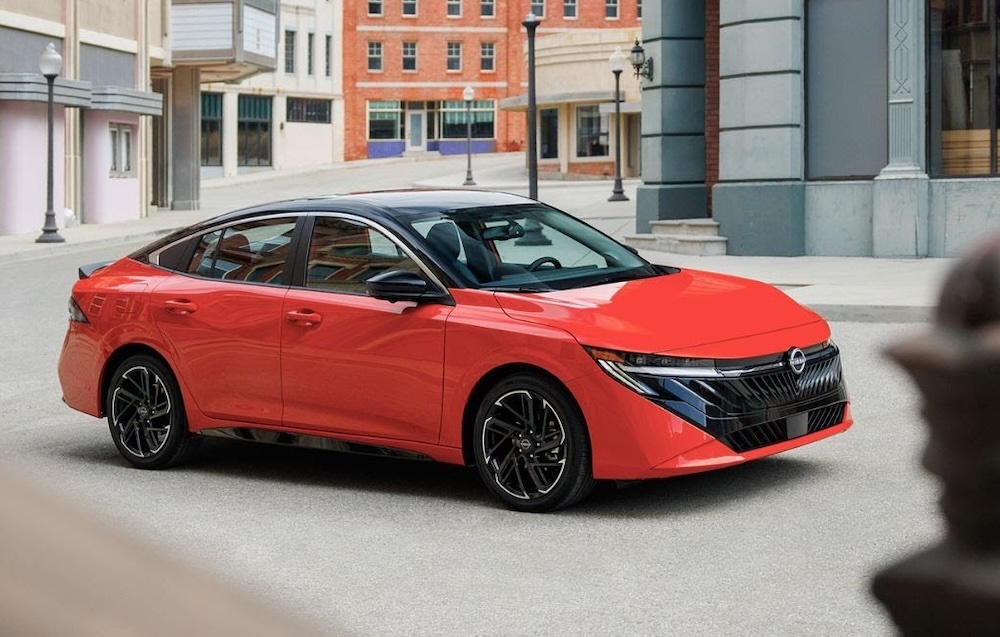
The 2026 Nissan Sentra proves you don’t need to spend luxury money to get a sedan that looks good, feels solid, and sips fuel. Once viewed as a budget commuter, the Sentra has evolved into one of the most comfortable and composed compact sedans in its class. With a light refresh for 2026 that adds subtle design tweaks, upgraded tech, and smarter safety integration, it remains one of the most accessible new cars you can buy today.
From the outside, the Sentra looks more upscale than you’d expect for a car that starts under $23,000. Nissan’s signature V-Motion grille, sharp LED headlights, and sculpted lines give it a strong, confident presence on the road. The SR trim adds sporty flair with black wheels, dark chrome accents, and a lower stance that gives the impression of something far pricier. It’s a small sedan with a grown-up look—something that can hold its own next to the Honda Civic or Toyota Corolla in the driveway.
Inside, the Sentra continues to impress with materials and design that punch above its weight. The cabin feels thoughtfully laid out, with soft-touch surfaces where it counts and a modern dashboard design anchored by a 7-inch or available 8-inch touchscreen infotainment system. The flat-bottom steering wheel and zero-gravity front seats—borrowed from Nissan’s higher-end models—add a touch of comfort you’ll actually notice after an hour behind the wheel. Rear seat space is generous for the segment, and the 14.3 cubic feet of trunk space make it surprisingly practical for weekend trips.
Power comes from a 2.0-liter four-cylinder engine producing 149 horsepower and 146 lb-ft of torque, paired with Nissan’s latest Xtronic CVT. No, it’s not fast—but it’s smooth, efficient, and more responsive than before thanks to software updates that simulate real gear shifts under acceleration. Expect around 32 mpg city and 41 mpg highway, making it one of the most fuel-efficient non-hybrid sedans you can buy. The steering feels light but predictable, the suspension tuning soaks up rough pavement well, and overall refinement makes it an easy car to live with every day.
Technology and safety take another step forward for 2026. The Sentra now includes wireless Apple CarPlay and Android Auto, along with an upgraded interface that’s faster and more intuitive. Nissan’s Safety Shield 360 suite comes standard, adding features like automatic emergency braking, lane departure warning, blind-spot monitoring, rear cross-traffic alert, and adaptive cruise control. On higher trims, available extras like a surround-view camera system and heated front seats give it a near-premium feel for the price.
Pricing remains one of the Sentra’s biggest advantages. The base S trim starts at around $22,500, the SV hits the sweet spot at $24,000, and the fully loaded SR tops out just under $27,000. For what you get—comfort, safety, and a modern design—the value is hard to beat. Compared with competitors like the Hyundai Elantra, Toyota Corolla, and Honda Civic, the Sentra delivers more standard safety tech and a smoother ride, though it doesn’t match the Civic’s sportiness or the Corolla’s hybrid option.
The 2026 Nissan Sentra isn’t trying to be flashy or fast—it’s trying to be smart. And it succeeds. It’s a car built for people who just want something reliable, affordable, and genuinely comfortable to drive. For first-time buyers, commuters, or anyone tired of inflated car prices, it’s a safe, sensible, and surprisingly refined choice.
Before you buy, check real-time dealer invoice pricing and incentives in your ZIP code at Quotes.EverymanDriver.com. It’s free, quick, and could save you hundreds—or even thousands—on your next Nissan Sentra or any new car on your list.