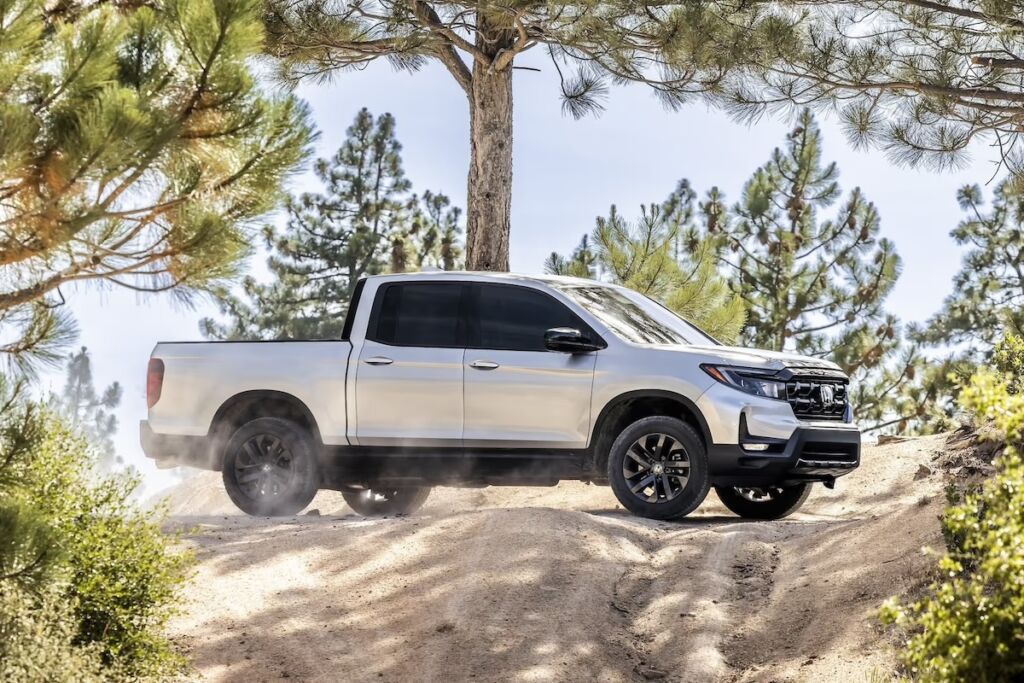
The Honda Ridgeline has spent years being told it isn’t a “real truck,” and I’ve never really understood the obsession with that argument. My press loan was the 2026 Ridgeline TrailSport, and the more time you spend with this truck, the more obvious its mission becomes. Honda isn’t trying to build another Tacoma. The Ridgeline is for somebody who wants a pickup bed, decent towing capability and all-wheel drive, but also wants something comfortable enough to drive every single day.
That difference starts underneath. The Ridgeline uses unibody construction instead of the traditional body-on-frame setup you’ll find in trucks like the Toyota Tacoma, Ford Ranger, Nissan Frontier and Chevy Colorado. Hardcore truck buyers may immediately see that as a negative, but for everyday driving it’s one of the Ridgeline’s biggest strengths. The ride is comfortable, it feels planted on the highway and you don’t get as much of that bouncing and movement you sometimes experience in an empty midsize pickup.
Honda keeps the powertrain simple. Every 2026 Ridgeline gets a 3.5-liter V6 making 280 horsepower, paired with a nine-speed automatic transmission and Honda’s i-VTM4 all-wheel-drive system. There’s no turbo four-cylinder, no hybrid and no long list of engine choices to sort through. The V6 isn’t going to pin you to the seat, but power delivery is smooth and predictable, and there’s something refreshing about a naturally aspirated V6 in a segment where turbocharged engines have become increasingly common.
My TrailSport adds the more adventurous side of the Ridgeline. You get all-terrain tires, an off-road-tuned suspension, additional underbody protection and selectable drive modes for conditions including snow, sand and mud. I wouldn’t confuse the TrailSport with something like a Tacoma TRD Pro if serious rock crawling is on your weekend schedule, but that’s probably not what most Ridgeline owners are doing anyway. For forest roads, snow, camping trips and getting to places a typical crossover might struggle with, the TrailSport gives you a little more capability without ruining the everyday ride.
Inside is where the Ridgeline really starts separating itself from traditional trucks. The driving position is comfortable, visibility is good and the cabin has the kind of straightforward layout Honda generally does well. The TrailSport also brings leather-trimmed seats with orange stitching, heated front seats, a heated steering wheel, tri-zone climate control, a moonroof and a power sliding rear window. It doesn’t feel like you’re sacrificing comfort just because you wanted something with a pickup bed behind you.
The technology is easy enough to figure out without sitting in your driveway for 20 minutes watching tutorials. There’s a 9-inch touchscreen with wireless Apple CarPlay and Android Auto, wireless phone charging and the usual collection of Honda driver-assistance features. Honda Sensing includes things like adaptive cruise control, collision mitigation braking and road departure mitigation, while the TrailSport also gets blind-spot monitoring, rear cross-traffic monitoring and parking sensors. Nothing revolutionary here, but most of what you need is present and easy to use.
Then there’s the bed, which remains one of my favorite things about the Ridgeline. The dual-action tailgate can either drop down normally or swing open from the side, and underneath the bed floor is Honda’s lockable In-Bed Trunk. That gives you a weather-resistant place for tools, groceries, luggage, recovery gear or anything else you don’t necessarily want sliding around the bed. The rear seats also fold up, creating another surprisingly useful cargo area inside the cab. These are the kinds of features that may not sound exciting on a spec sheet but become really useful once you own the truck.
Towing capacity is 5,000 pounds, which is going to be enough for plenty of boats, utility trailers and smaller campers, but this is one area where you need to be realistic about what you need. Several traditional midsize pickups can tow considerably more. If towing 6,000 or 7,000 pounds is part of your normal routine, I’d probably look elsewhere. If you occasionally tow something lighter and spend the other 95 percent of your time commuting, hauling gear and running errands, the Ridgeline’s tradeoff starts looking pretty reasonable.
The lineup begins with the Sport at $40,795, followed by the RTL at $43,595, TrailSport at $45,995 and Black Edition at $47,395 before destination and options. For me, the RTL is probably where value shoppers should spend some time because you get many of the comfort upgrades without crossing too far into the upper-$40,000 range. But if you like the tougher look, all-terrain tires and added capability, the TrailSport makes a strong case. I’d just think carefully before piling accessories onto one because once you get close to $50,000, the number of trucks competing for your money gets pretty large.
The 2026 Honda Ridgeline isn’t the truck I’d recommend to somebody who wants maximum towing, extreme off-road capability or simply wants the toughest-looking pickup in the parking lot. But for somebody who uses a truck as an everyday vehicle and occasionally needs the bed, towing capability and all-wheel drive, it may actually be one of the smarter choices in the segment. The TrailSport adds enough personality and capability to make it interesting without giving up what the Ridgeline does best: being comfortable and easy to live with.
Before heading to a Honda dealership, visit Quotes.EverymanDriver.com, enter your ZIP code and compare local dealer pricing so you have some real numbers before you start negotiating.