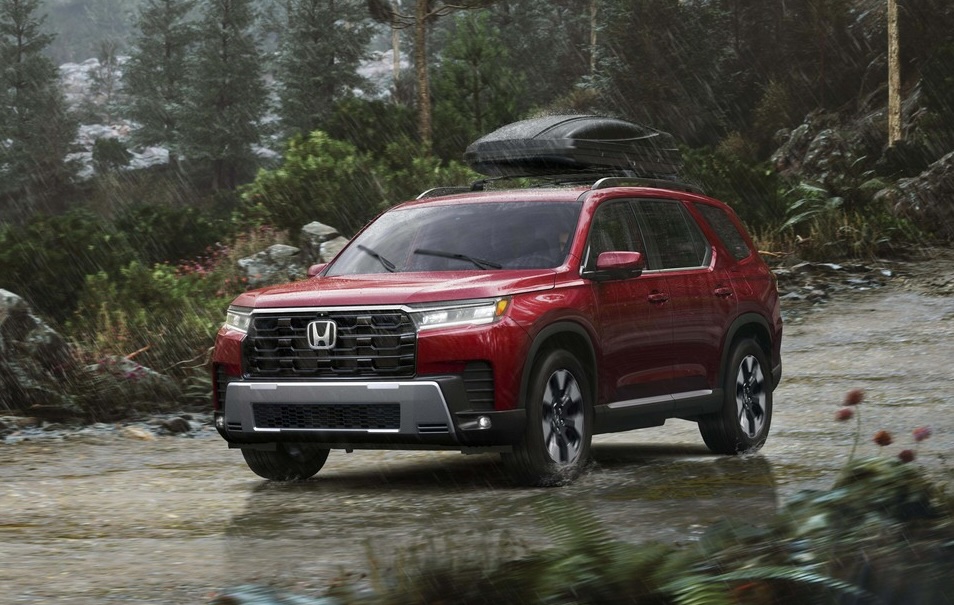
The 2026 Honda Pilot just got the kind of refresh families actually feel every single day: a much larger, faster touchscreen, a noticeably quieter cabin, sharper steering feel, bolder styling, and meaningful safety upgrades across the board. This isn’t Honda “moving the cupholders around” — it’s Honda protecting the Pilot’s reputation as the default answer in the midsize 3-row SUV class for buyers who want a do-it-all family hauler that still feels confident behind the wheel.
The big headline is the tech leap. Every 2026 Pilot now runs a new ultra-wide 12.3-inch HD touchscreen (Honda says it’s 37% larger) with updated software for smoother response, plus wireless Apple CarPlay, wireless Android Auto, Google built-in, and 5G Wi-Fi capability. Honda also upgrades the driver’s view with a larger 10.2-inch digital instrument display (listed as 43% larger), which makes the whole cabin feel more modern without turning it into a distracting rolling tablet.
Honda didn’t stop at screens — they went after refinement. The Pilot’s cabin is now quieter by roughly 2–3 dB in key frequencies thanks to upgrades like semi-tempered door glass, added insulation, and additional sound-absorbing changes. Touring and Elite go further with extra noise-reduction hardware (like enclosed fender liners). For families, that translates into a calmer highway experience, less fatigue on road trips, and a cabin that feels more premium even if you didn’t buy the top trim.
Under the hood, the Pilot sticks with what works: a 3.5-liter DOHC V6 making 285 hp and 262 lb-ft, paired to a 10-speed automatic tuned for the Pilot. Translation: you’re getting proven, predictable power that feels smooth and “ready” when the vehicle is loaded with passengers and gear. This is also why the Pilot tends to feel less stressed than some rivals when you’re doing real family driving—merging, mountain grades, and towing weekend toys.
One of the most important upgrades for 2026 is steering feel. Honda retuned the electric power steering for more precision and feedback, with more stable on-center weight for calmer highway tracking. In plain English: fewer little corrections, more confidence in lane, and a Pilot that feels more planted in everyday traffic—especially valuable in a big family SUV that often lives in stop-and-go, school zones, and busy suburban roads.
The trim strategy stays clean and purposeful: Sport, EX-L, Touring, TrailSport, Elite, and Black Edition. Pricing starts at $42,195 for the Pilot Sport (plus $1,495 destination). Sport and EX-L are positioned as the “family value” trims, Touring is the long-trip upgrade, Elite is the comfort-tech sweet spot, and Black Edition is the fully loaded “treat yourself” spec with the dark styling that buyers clearly love.
The feature changes that matter in real life show up all over the lineup. A power tailgate is now standard on every 2026 Pilot, which is one of those daily-life upgrades you appreciate every time your hands are full. Roof rails are added to EX-L, and Touring gains a 360-degree surround-view camera that used to be locked higher in the lineup—a big deal for tight garages, curb dodging, and overall stress reduction when parking a 3-row SUV.
Safety gets a meaningful bump with a new Post-Collision Braking system (PCB) on every 2026 Pilot to help mitigate damage and injuries in multi-collision incidents. Honda Sensing remains standard across the lineup, including Collision Mitigation Braking, Road Departure Mitigation, Lane Keeping Assist, and Adaptive Cruise Control. These aren’t “wow” features in a brochure, but they’re exactly the kinds of systems that help families feel more confident day to day.
TrailSport continues to be the “family adventure” pick, and Honda keeps pushing it toward legitimate capability rather than just rugged looks. You’re getting the i-VTM4 AWD system standard, steel skid plates, an off-road tuned suspension with additional ground clearance, and all-terrain tires designed to improve traction in dirt, sand, mud, rocky terrain, and snow—without turning the Pilot into a noisy penalty box on pavement. For 2026, TrailSport also adds heated 2nd-row outboard seats and offers a brown leather interior option with contrast stitching, which is a smart way to blend outdoorsy hardware with a premium cabin vibe.
Fuel economy stays realistic for a V6 3-row. Sport 2WD is rated 19/27/22 (city/highway/combined), Sport AWD 19/25/21, EX-L 2WD 19/27/22, EX-L AWD 19/25/21, and most AWD trims land at 19/25/21. TrailSport is the trade-off trim at 18/23/20—basically the cost of the off-road hardware and tires that make it more trail-capable. If you’re honest about your driving (mostly pavement, occasional snow), the non-TrailSport trims will typically be the more efficient daily play.
The 2026 Pilot’s thesis is simple: one SUV that does family duty without feeling flimsy, outdated, or annoying to live with. The refresh attacks the right targets—tech speed, cabin quiet, steering confidence, safety, and bolder styling—while keeping the V6 + 10-speed formula that makes this thing feel ready for real life. Shopping advice: EX-L AWD is likely the value sweet spot for most families, Touring is the smart upgrade if you want the added camera tech and premium touches for road trips, and TrailSport is the correct choice if your weekends actually involve dirt roads, snow country, and trailheads. And if you’re pricing any Pilot (or cross-shopping Highlander, Telluride, Palisade, Traverse, or Grand Cherokee L), don’t guess—run real offers in your area at Quotes.EverymanDriver.com so you can see who’s competing and who’s inflating the deal.