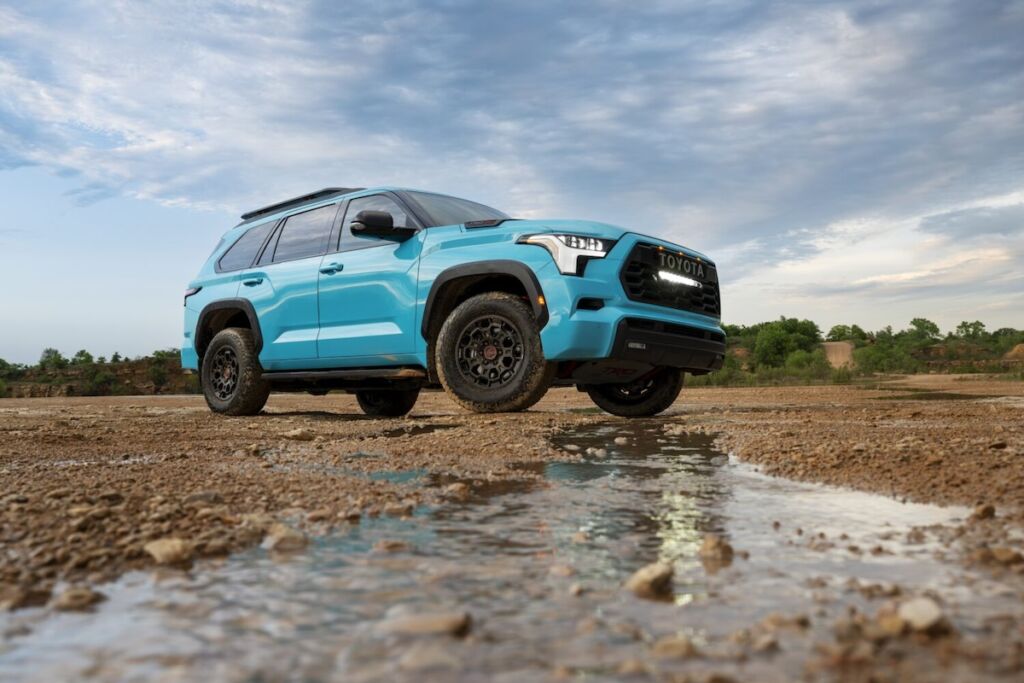
The first thing that hit me about the 2026 Toyota Sequoia TRD Pro Hybrid is how little drama there is in the way it delivers big-SUV capability. That surprised me. Usually when a full-size SUV tries to look this tough, it drives like a rolling compromise and asks you to pretend that’s part of the charm. Not here. This thing has real attitude, real torque, and just enough day-to-day polish to make you stop and say, hold on, Toyota may have figured out a smarter formula than a lot of buyers realize.
The Sequoia TRD Pro is still a body-on-frame brute, so let’s not kid ourselves. It’s big, tall, wide, and not exactly subtle. But Toyota didn’t build this version for people who want subtle. It built it for buyers who want a family-sized SUV that can tow, haul, road-trip, and still look like it belongs on a trailhead instead of in a suburban school pickup line. It’s the Sequoia for people who want capability first and excuses later.
Under the hood, every 2026 Sequoia gets Toyota’s i-FORCE MAX hybrid setup, which pairs a twin-turbo 3.4-liter V6 with a 10-speed automatic. The numbers matter here: 437 horsepower and 583 lb-ft of torque. That’s not brochure fluff. That’s the reason this SUV feels strong the second you lean into the throttle. The smart part is where that torque shows up. It doesn’t need to scream to get moving. It just goes. Hard. That’s what makes it feel expensive in a good way.
I noticed this while filming a few low-speed pulls and rolling merges: the Sequoia TRD Pro doesn’t feel frantic. It feels unbothered. That’s a better compliment. Big SUVs don’t need to be “fun” in the sports-sedan sense. They need to feel confident, easy, and unshaken when you load them with people and gear. On my test loop, the steering felt light enough to live with, the body control stayed tidy for something this size, and the ride never crossed over into fake-truck harshness. That matters more than a flashy spec sheet.
The TRD Pro part is not just stickers and marketing chest-thumping. You get standard part-time 4WD, Multi-Terrain Select, Crawl Control, Downhill Assist Control, an electronically locking rear differential, Multi-Terrain Monitor, and the kind of factory off-road tuning that gives this thing real credibility when the pavement ends. Add the trail-tuned suspension, skid plates, and all-terrain tires, and this is not some soft suburban trim with a rugged name. Toyota actually did the homework here.
That said, this is still a full-size SUV trying to do a lot of jobs at once, and packaging is where the Sequoia remains a little imperfect. The front and second rows are easy to live with, and there’s solid storage for family clutter, weekend bags, and all the junk real people actually carry. The third row is better than some critics make it sound, but I’m not here to sugarcoat it: it’s still better for kids or shorter trips than full-time adult duty. Cargo space is useful, with 22.3 cubic feet behind the third row and up to 86.9 cubic feet with the rear seats folded, but this is not the roomiest cave in the segment.
Toyota cleaned up a few useful details for 2026, and those are the kinds of changes I actually care about. Power-folding third-row seats are now standard across the lineup, which is one of those upgrades that sounds minor until you use it a few times and realize it should have been there already. The TRD Pro also gets the exclusive new Wave Maker color, which is pure Toyota TRD energy: loud enough to stand out, but not cartoonish. Love it or hate it, you won’t confuse it for another big SUV in the Costco parking lot.
Inside, the Sequoia still leans more practical than flashy, and honestly, that works in its favor. Limited and up get the larger 14-inch touchscreen, while the interface itself remains simple enough that you’re not fighting the menu every time you want to change something. Wireless Apple CarPlay and Android Auto are there, USB-C ports are everywhere, and the physical knobs for volume and climate are the kind of old-school decision I wish more automakers would keep making. Touchscreen-only controls are not progress. They’re a nuisance.
Safety tech is strong and, more importantly, it covers the stuff buyers actually use. Toyota Safety Sense 2.5 is standard, along with adaptive cruise, lane-keeping support, automatic emergency braking, blind-spot monitoring, rear cross-traffic alert, parking assist, and a rear-seat reminder. The available camera views are especially useful in something this large. You don’t need to be an off-road hero to appreciate that. They help in tight garages, crowded lots, and anywhere concrete poles are lurking, waiting for your attention to slip.
Now for the part dealers won’t lead with. Fuel economy is decent for a full-size body-on-frame SUV, but the TRD Pro is not a miracle machine. Lower trims hover around 22 mpg combined, while the heavier upper trims, including TRD Pro, are closer to 20 mpg combined. That’s respectable, especially compared with the old V8-school mindset, but it’s still mid-pack in the real world. If you’re expecting hybrid-badge magic at the pump, reset your expectations. This hybrid is here to deliver torque and usefulness first, fuel savings second.
Here’s how dealers will try to sell you this thing: they’ll act like the TRD Pro is the obvious Sequoia to buy because it looks the coolest and carries the most lifestyle heat. That’s only half true. The TRD Pro absolutely makes sense if you’ll use the off-road hardware, want the tougher look, or just refuse to blend in. But if your life is mostly highways, school runs, Costco hauls, and family road trips, the Limited is still the lineup’s smartest buy. It starts a lot lower, gets the same powertrain, and avoids a chunk of the TRD Pro premium.
Here’s where you’ll overpay: buying the TRD Pro because you like the image more than the mission. That’s the trap. At around $80,765, this trim is expensive enough that you need a reason beyond “it looks awesome.” Because yes, it does look awesome. But cool costs money. If you’re not going off pavement, not using the trail gear, and not specifically wanting the TRD Pro identity, you can spend less and live just as happily in a lower trim. Toyota didn’t miss with this version, but your wallet still deserves a vote.
Here’s what I’d watch for on a test drive. First, pay attention to how the brake pedal feels at low speeds in stop-and-go traffic, because hybrid systems can sometimes have a weird handoff feel that bugs some drivers more than others. Second, do a tight parking-lot loop and a three-point turn, because that’s where a big SUV quickly reminds you what daily life will actually feel like. Third, hit a rough patch of road and then roll into a highway merge. That combo tells you almost everything: ride quality, body control, steering ease, and whether the powertrain feels natural or staged.
My strong take? Toyota built a better full-size SUV than a lot of people want to admit. Not perfect. Not cheap. But smart. Very smart. The Sequoia gives up some third-row room to rivals like the Chevy Tahoe and Suburban, but it punches back with hybrid torque, strong standard safety tech, and a calmer ownership story than some competitors. The Ford Expedition is roomy and quick, the Jeep Wagoneer plays the premium game hard, but the Sequoia feels like the one designed by adults who know families actually keep vehicles for a long time. Agree or disagree? Tell me in the comments, because I know some of you will take the Tahoe side of this argument.
Here’s what I’d actually do. If I needed a full-size SUV and wanted the most balanced version, I’d still start with the Limited. If I wanted a factory-built big SUV that can handle dirt, weather, towing, and family duty without looking apologetic about any of it, then yes, I’d step up to the TRD Pro and never look back. The 2026 Toyota Sequoia TRD Pro Hybrid is a real-deal full-size SUV with serious torque, useful tech, honest off-road chops, and just enough polish to justify its place on your shortlist. Just don’t buy it blind, and don’t buy it emotionally. Before you sign anything, compare real dealer pricing at Quotes.EverymanDriver.com so you don’t overpay.