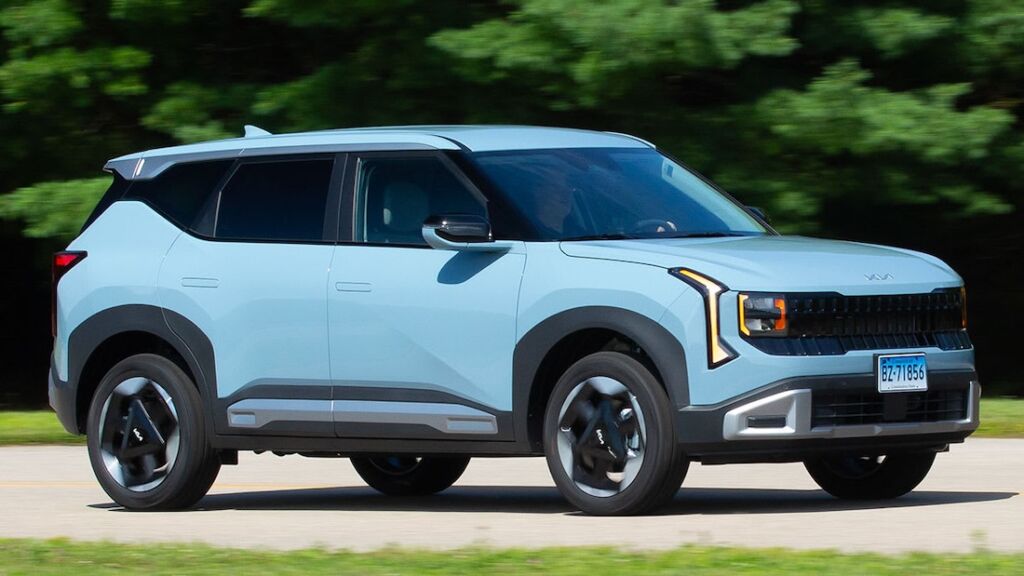
The Kia Seltos has always lived in that interesting space between the really small entry-level crossovers and larger compact SUVs like the Sportage, CR-V and RAV4. For 2027, Kia has completely redesigned it, and this isn’t one of those updates where you need to park the old one next to the new one to see what changed. The Seltos is bigger, more refined, better looking and packed with more technology, while still starting at $24,990 before destination. If you want an SUV but don’t necessarily want the size or price that comes with moving up another class, this new Seltos deserves a look.
The exterior is probably the first thing you’ll notice because the new Seltos looks considerably more substantial than the vehicle it replaces. There’s definitely some Telluride influence here, especially in the more upright front end, squared-off body and lighting. Kia stretched the wheelbase by more than two inches and made the vehicle longer, wider and slightly taller. The result is a small SUV that no longer looks quite so small. The X-Line versions featured in the accompanying video take that even further with black exterior accents, unique wheels, roof rails and a slightly tougher appearance.
Growing the Seltos also helped where it matters more: inside. Rear legroom has increased to around 39 inches, which is impressive for something that still falls into the subcompact SUV category, and there’s more shoulder room up front as well. This has always been one of the reasons I liked the basic idea behind the Seltos. You’re getting something that’s easy to maneuver and park without automatically giving up usable passenger space. For somebody who occasionally carries adults in the back seat, that extra room could be more important than another horsepower number on the spec sheet.
The dashboard has also been completely modernized. Depending on trim and equipment, you can get a pair of 12.3-inch displays stretching across much of the dashboard, wireless Apple CarPlay and Android Auto, available wireless charging and an available Harman Kardon audio system. Higher trims can also add things like ventilated front seats, a surround-view camera, Blind-Spot View Monitor and Highway Driving Assist. Some of that equipment wasn’t that long ago reserved for significantly more expensive vehicles, and Kia continues to be pretty aggressive about bringing technology down into its smaller models.
There are two familiar gasoline engines at launch. Most Seltos trims use a 2.0-liter four-cylinder making 147 horsepower paired with a continuously variable transmission. That’s probably going to be perfectly adequate for somebody who spends most of the time commuting and running around town, but I wouldn’t expect much excitement from it. The X-Line SX gets the engine I’d want to try before buying: a turbocharged 1.6-liter four-cylinder producing 190 horsepower and 195 pound-feet of torque, connected to a traditional eight-speed automatic transmission.
Now, 190 horsepower sounds pretty healthy in a small SUV, but there is a catch. The redesigned Seltos has gained some weight, so the turbo version isn’t dramatically quick. Car and Driver recorded 0-to-60 mph in 8.2 seconds in an X-Line SX. I don’t think that’s a deal-breaker because this isn’t supposed to be a performance SUV, but it’s another reason I always tell people to drive the exact engine they’re considering. Don’t automatically spend more money because the brochure says “turbo.” Make sure you can actually feel enough of a difference to justify it.
All-wheel drive is available, while the X-Line models make AWD part of their personality. Kia also offers a multi-terrain system with settings for mud, snow and sand on appropriately equipped versions. Again, keep expectations realistic. This isn’t a Wrangler or a 4Runner, and I wouldn’t buy a Seltos because I planned to spend every weekend crawling over rocks. But if you live somewhere with real winters, regularly drive forest roads or simply want some extra confidence when conditions get bad, the AWD versions make a lot of sense.
Cargo space is another area where growing the Seltos pays off. Kia is claiming class-leading maximum cargo room, and the more squared-off shape makes the space behind the rear seat easier to use. That’s important because practicality is ultimately one of the main reasons to buy something like this instead of a similarly priced sedan. If you’ve got kids, dogs, groceries, luggage, golf clubs or camera equipment going in and out of the vehicle regularly, the combination of a hatchback opening and folding rear seats makes life considerably easier.
The 2027 lineup gives buyers five gasoline trims, starting with the LX and working through S, EX and the more rugged-looking X-Line models. The X-Line SX featured in the video sits at the top and starts around $32,790 before destination, and an available Prestige Package can push a loaded example well into the upper-$30,000 range. That’s where I’d slow down. A loaded Seltos is nice, but once you’re approaching $40,000, you’re getting close to larger SUVs including Kia’s own Sportage. For value, I’d spend some time with the middle trims before automatically checking every option box.
Overall, I think the all-new 2027 Kia Seltos is much more interesting than the outgoing model. It looks better, there’s more room inside, the ride and refinement have improved, and buyers can still get into one for less than $25,000 before destination. The X-Line SX gives you the turbo engine, AWD and most of the toys, but it isn’t automatically the version I’d buy with my own money. The sweet spot may be farther down the lineup where you keep most of the new Seltos’ improvements without turning a relatively affordable small SUV into a $37,000 purchase.
Before visiting a Kia dealership, go to Quotes.EverymanDriver.com, enter your ZIP code and compare local dealer pricing so you know what these vehicles are actually selling for in your area.