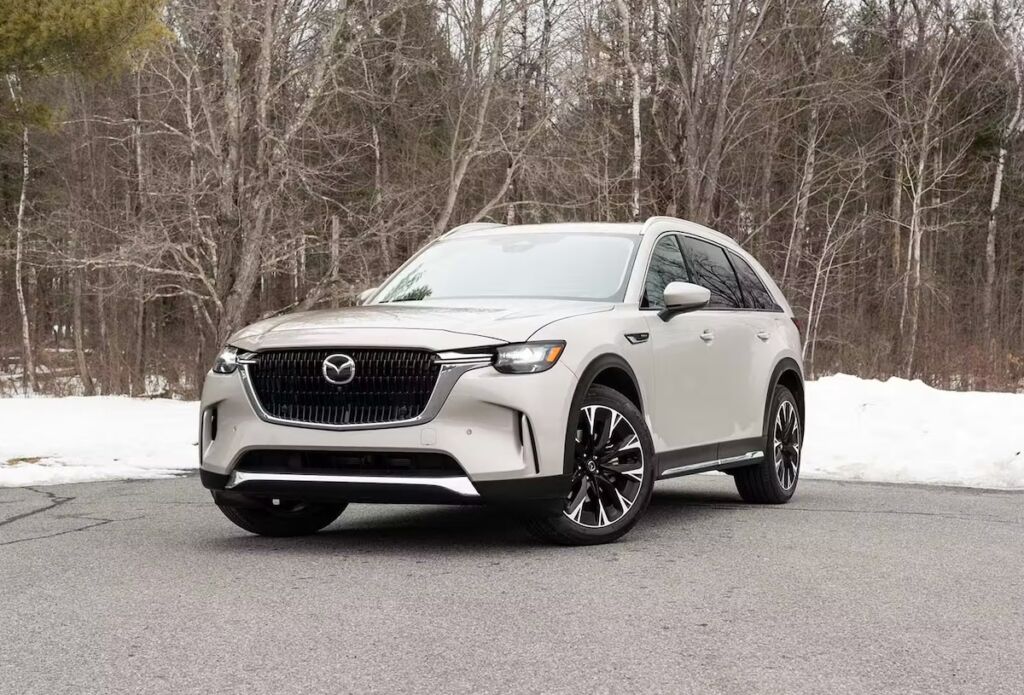
I didn’t expect the 2026 Mazda CX-90 PHEV to be this easy to like and this easy to overspend on at the same time. That’s the surprise. On paper, it sounds like a slam dunk: three rows, plug-in-hybrid flexibility, 323 horsepower, standard all-wheel drive, and a premium-looking cabin. But once you slow down and look at the trim ladder, the electric range, and the real-world mission, this thing starts looking less like an automatic yes and more like a classic “buy the right version or regret it later” SUV.
Mazda keeps the 2026 CX-90 PHEV lineup simple. There are three trims: Preferred at $50,495, Premium Sport at $55,300, and Premium Plus at $58,500, before Mazda’s $1,530 destination charge. That means this is not some bargain plug-in for budget shoppers. This is a premium-priced family SUV wearing a Mazda badge, and that changes the conversation fast.
The powertrain is legitimately strong. Every 2026 CX-90 PHEV uses a 2.5-liter four-cylinder, a 68-kW electric motor, and an 8-speed automatic, with total output rated at 323 horsepower and 369 lb-ft of torque on premium fuel. Use regular and Mazda’s own specs show output dips to 319 horsepower, while torque stays the same. That’s worth knowing, because here’s how dealers will try to sell you this thing: they’ll quote the big horsepower number and skip the part where premium fuel is how you get all of it.
Efficiency is decent, but this is where some buyers need a reality check. Mazda rates the CX-90 PHEV at 56 MPGe combined, 26 mpg combined when you’re running as a regular hybrid, and an EPA-estimated 27 miles of EV range with up to 500 miles total range. That makes it useful for short electric errands and school-run duty if you charge often, but let’s not pretend it’s some long-range electric substitute. Twenty-seven miles is helpful. It is not life-changing.
Charging is also better framed as convenient than impressive. Mazda says the 17.8-kWh battery can charge from 20 to 80 percent in about 6 hours 40 minutes on Level 1 and about 1 hour 30 minutes on Level 2. In other words, this works best if you have home charging and a routine. If you’re the kind of buyer who never plugs in consistently, don’t kid yourself. You’re basically paying extra for a plug you won’t use enough.
Size and utility are strong selling points. The CX-90 PHEV rides on a 122.8-inch wheelbase, stretches just over 201 inches long, seats up to seven, and offers between 14.9 and 15.9 cubic feet of cargo space behind the third row depending on seating configuration. Fold rows down and that grows to as much as 74.2 to 75.2 cubic feet, and towing capacity is rated at 3,500 pounds. Those are real family numbers. This thing isn’t pretending to be useful. It actually is.
Inside, Mazda is still doing what Mazda does best: making mainstream money feel a little more upscale than it probably should. Every trim gets a 12.3-inch center display and a 12.3-inch digital instrument cluster, while upper trims add an Active Driving Display. You also get wireless charging, available Bose 12-speaker audio, and on higher trims, wireless Apple CarPlay and Android Auto with added touchscreen capability. That’s a strong cabin story. The materials and presentation are going to win a lot of people over before the numbers even enter the chat.
The trim walk is where the trap starts. Preferred already gives you leather-trimmed seats, heated and ventilated front seats, heated second-row seats, a heated steering wheel, a moonroof, and 21-inch wheels. Premium Sport adds things like a panoramic moonroof, hands-free liftgate, Bose audio, auto-folding mirrors, and a blacked-out exterior treatment. Premium Plus piles on Nappa leather, a head-up display, and more upscale trim details. Nice stuff. But nice stuff is exactly how shoppers talk themselves from fifty grand to almost sixty.
Here’s where you’ll overpay: the Premium Plus. Not because it’s bad. Because it’s too easy to justify emotionally. The moment you see Nappa leather, a panoramic roof, and the prettiest version on the lot, the deal starts sounding smarter than it really is. Here’s what I’d actually do: I’d start with the Preferred, then look hard at Premium Sport if I really wanted the upgraded look and audio. That feels like the sweet spot. Premium Plus feels like the “I was already spending a lot, so what’s a few thousand more?” trim. That logic gets expensive fast.
What I’d watch for on a test drive is not just acceleration. Everybody will notice the 323 horsepower. I’d focus on brake feel and powertrain transitions. In a plug-in hybrid, the difference between a smooth, natural setup and an annoying one shows up when you’re modulating the brake pedal in traffic or when the gas engine wakes up under load after electric driving. If that handoff feels clunky or the brake pedal feels inconsistent, you’ll notice it every single day. That matters more than a quick on-ramp burst.
I’d also test the third-row access and cargo setup before signing anything. Mazda offers optional second-row captain’s chairs on some configurations, and cargo volume varies depending on how the seating is set up. So don’t assume the version you like visually is the one that works best for your family. Bring the stroller. Bring the hockey bag. Bring the awkward Costco box. This is exactly the kind of SUV people buy for “space,” then realize later they never actually checked their own version of space.
I noticed this while filming three-row SUVs: the CX-90 always looks smaller and sleeker on camera than something this practical usually does. That’s part of the appeal. It doesn’t scream minivan replacement the way some bulky family haulers do. But that cleaner, more premium shape is also why people start shopping it with their eyes instead of their brains. Mazda’s styling can absolutely talk you into spending more than your use case requires. That’s not hype. That’s how this brand works when it’s on its game.
Ownership peace of mind is reasonably solid. Mazda’s standard new-vehicle warranty is 3 years or 36,000 miles, powertrain coverage runs 5 years or 60,000 miles, and Mazda says the CX-90 PHEV’s high-voltage battery is covered for 8 years or 100,000 miles. That won’t erase concerns about long-term complexity for every buyer, but it does make the plug-in side of the equation easier to live with if you plan to keep it a while.
My strong opinion? The CX-90 PHEV is a better Mazda than it is a pure value play. That’s the distinction. It’s handsome, quick, upscale, and actually useful, but it’s also a three-row plug-in hybrid with only 27 miles of electric range and a price that can brush $60,000 before fees. That means you need to be brutally honest about what you want. Do you want a smart family SUV with some electric flexibility, or do you want the nicest Mazda on the lot because it feels special? Those are not the same thing.
The verdict is simple. The 2026 Mazda CX-90 PHEV is one of the more compelling plug-in family SUVs because it combines real performance, real utility, and a cabin that feels a class above where Mazda usually plays. But it is also very easy to spec into expensive territory without getting a matching jump in day-to-day usefulness. Buy the right trim, charge it consistently, and it makes a lot of sense. Buy the wrong trim for the wrong reason, and it becomes a very polished way to overspend. Before you sign anything, compare real-world dealer pricing first at Quotes.EverymanDriver.com so you don’t overpay for the wrong version.