The 2026 Mazda CX-70 returns this year with no major changes—and that’s not a bad thing. Mazda already hit a sweet spot with the CX-70: a two-row SUV that blends luxury-lite design, punchy powertrains, and some of the best handling in the segment. If you want something that feels more engaging than a Hyundai Santa Fe but far more attainable than a BMW X5, this is the SUV that threads the needle. Mazda’s goal was simple: offer a five-passenger vehicle with real performance cred, upscale materials, and everyday usability without the bulk of a third row. In practice, the CX-70 is one of the most balanced, satisfying midsize SUVs you can buy.
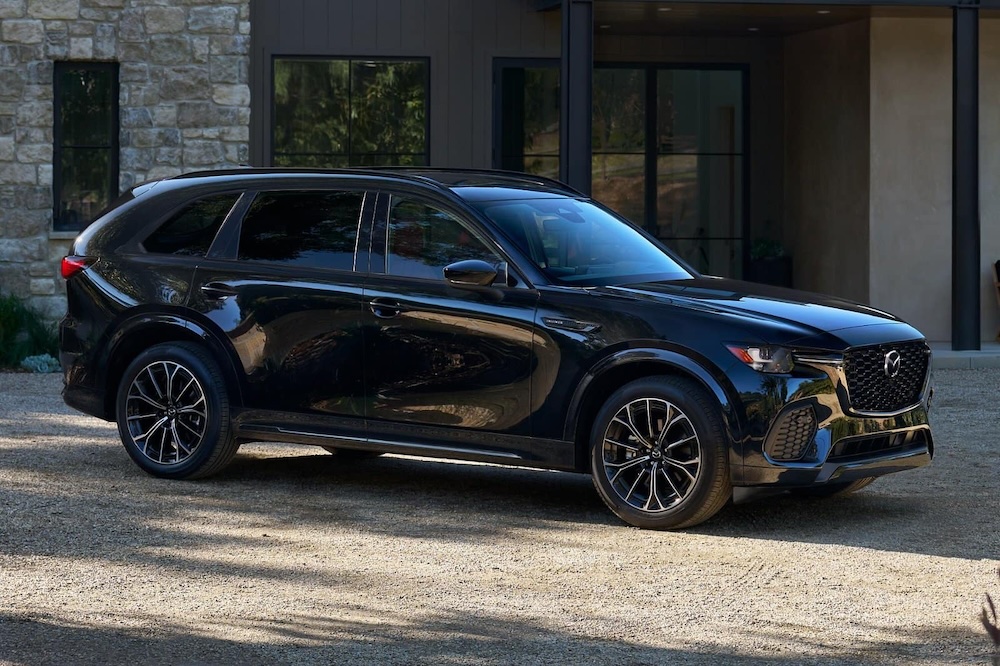
The CX-70 looks the part of a premium SUV without screaming for attention. Its long hood, rear-drive proportions, and subtle body sculpture give it more presence than many of its rivals. Wheel arch finishes help you spot which powertrain you’re looking at: black cladding on mild-hybrid models, painted flares on the PHEV. The S trims get 21-inch wheels, adaptive front lighting, dark exterior accents, and a panoramic roof that brings some visual drama. Mazda doesn’t chase gimmicks here; the CX-70 has that understated, confident design language typically reserved for pricier German brands.
Slide inside and the premium vibe gets clearer. The CX-70 shares its architecture with the CX-90, so you get rich materials, a clean layout, padded touch points, and a cabin that feels genuinely upscale. Nappa leather, quilted patterns, upgraded lighting, and memory seating arrive on upper trims, while the second-row seats recline for long-trip comfort. Cargo room is one of its secret strengths: 29.9 cubic feet behind the second row and 58.6 cubes with it folded, complete with an under-floor storage compartment that hides bags or gear from plain sight. It’s genuinely more useful than some rivals despite being a two-row SUV.
Under the hood, Mazda gives buyers three high-quality choices. The standard 3.3-liter inline-six mild hybrid delivers 280 horsepower and 332 lb-ft of torque, smooth power, and impressive real-world efficiency. Step up to the 340-horsepower “S” version of the same engine and the CX-70 becomes legitimately quick, with torque-rich passing power and the kind of throttle response you don’t usually find in this class. All models use an eight-speed automatic and standard AWD. The plug-in hybrid combines a 2.5-liter engine with a 100-kW motor for 325 hp, 369 lb-ft, and about 25 miles of electric driving—more than enough for errands or short commutes.
What sets the CX-70 apart, however, is how it drives. Mazda tuned this SUV with unusually sharp steering, predictable body control, and a chassis that feels eager in corners. It reacts quickly but never harshly, and the ride remains calm over broken pavement. It’s the sporty option in a class dominated by softer, slower responses, yet it never feels punishing. The PHEV’s blend of electric and gas power adds instant torque, making it feel stronger than its four-cylinder layout suggests. Regenerative braking comes in two levels—tunable enough that newcomers won’t find it abrupt.
Fuel economy remains strong for the category. The standard mild-hybrid returns around 24/28 mpg city/highway, while the more powerful S barely changes those numbers at 23/28. The PHEV leads the lineup with 56 MPGe and 25 miles of EV-only capability. These figures put Mazda right alongside or slightly ahead of some luxury rivals.
Tech usability remains the CX-70’s most polarizing point. The 12.3-inch center display is sharp, but it’s not a touchscreen—Mazda sticks with a rotary dial and shortcut buttons. Some drivers love the precision, others find it dated. Wireless Apple CarPlay and Android Auto are included, the wireless charger works reliably, and full Amazon Alexa integration is new to Mazda, allowing voice control for navigation, media, and even smart home devices. The Bose 12-speaker system on Premium trims is strong, but Mazda’s infotainment still trails competitors like BMW’s large touchscreen setup.
Safety remains comprehensive across the lineup. Standard gear includes blind-spot monitoring, radar cruise with stop-and-go, lane-keep assist, emergency braking, rear cross-traffic alert, and an unresponsive-driver support system. Premium Plus trims add surround-view cameras, front cross-traffic alert, and additional sensing tech. The CX-70 hasn’t been crash-tested as of this writing, but its sibling CX-90 earned top marks—an encouraging sign given their nearly identical structures.
Compared to rivals, the 2026 CX-70 plays an interesting role. It drives better than the Hyundai Santa Fe and Jeep Grand Cherokee. It undercuts the BMW X5 and Acura MDX on price while offering legitimately sporty handling. The Genesis GV80 is more luxurious, but Mazda’s driving dynamics make it feel special in a different way. This is the SUV for people who want something premium without the premium cost, and who care as much about the drive as the look.
The S Premium trim remains the best value in the lineup, offering the high-output inline-six, premium features, and strong towing capability at a fair price. Buyers wanting a greener angle or quieter urban operation should consider the PHEV Premium, which balances performance and efficiency well.
As a complete package, the 2026 Mazda CX-70 sticks to Mazda’s formula: upscale feel, engaging performance, excellent steering, and a cabin that makes daily life easy. It isn’t the flashiest, and the infotainment quirks may divide some shoppers, but for those who want a driver-focused SUV with premium touches and strong value, the CX-70 belongs on the short list.
If you’re considering the 2026 Mazda CX-70, check real-time dealer invoice pricing and incentives in your ZIP code at Quotes.EverymanDriver.com before you buy. It’s free, fast, and often saves shoppers hundreds—sometimes thousands—on their next SUV.